
The ring of Möbius
We made a loop that has only one edge and only one side: it is the ring (or band) of Möbius.
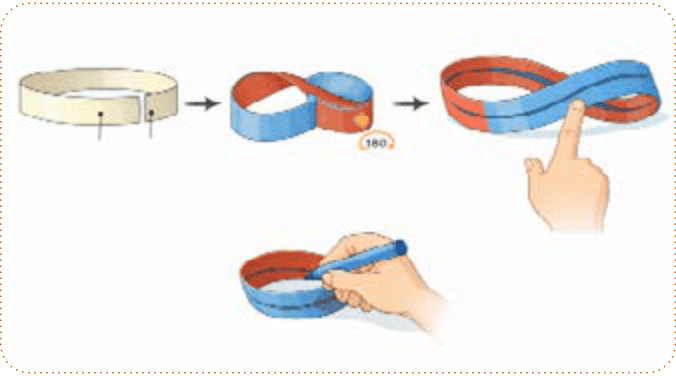
Photo gallery
Materials needed
Check the materials you have before starting.
Activity steps
Follow the steps in order.
Cut the tape
Cut in a sheet a ribbon about 3 cm wide in the direction of length.
Ordinary buckle
Paste both ends without twist to form a classic loop. Ask: how many edges and faces has this loop? (An expected answer: two edges and two sides.)
Make the ring of Möbius
Take a new strip, turn one end of a turn (180°), then stick it to the other end. You get a coloured Möbius ring.
Count edges and faces
Ask how many edges and faces have this ring. Let the group propose answers, then observe freely.
Follow the edge
Place a finger on a edge without lifting it and follow it: you return to the starting point — there is only one edge.
Coloring and tracing
Color what you think is the "inner" and the "outer": the colors come together. Also draw a continuous line on the surface: you cover the whole band and you come back to the beginning — one side.
Understand the science
We made a loop that has only one edge and only one side: it is the ring (or band) of Möbius. Its "length" of surface is equivalent to twice a face of an ordinary loop. If the Möbius ring is cut in half in the length direction, a loop is obtained twice as large as an ordinary loop. The colouring of one side and the drawing of a continuous line on the surface confirm that there is only one side and only one edge.
Everyday applications
The Möbius band illustrates topology ideas: objects that seem to have two sides sometimes have only one. It can be found in technical applications (carrier belts, circuits) and as a tool to discover geometry differently.
Safety precautions
- Handle scissors carefully, under the supervision of an adult.